Welcome to the Saruyama Blog, intermittent and generally off topic. Occasionally you might see some trees...and weird ones at that.

Friday, 21 October 2011

Satsuki a-go-go redux...

Following on from the previous post, here is a before and after.

The tree is a kaho or gyoten of considerable age, estimated at 80 years which makes it a granddaddy...but it was in very healthy condition. It had been repotted earlier this year, pruned then and again at the end of june. Both times had been half for balancing the vigour and half for creating the style. The work now was to take that balanced vigour and use it to redevelop some serious problems.

The apex had two major branch structures in so one was removed and the remaining apex spread out as much as possible. There is still a gap on the top left but it will fill out. The pointing branch on the left was accentuated and other branches lowered and spread out. The second right branch was bent severely (for an azalea) and so i used raffia and 6mm alumi wire. When wiring satsuki, go big or go home on wire thickness....the thicker the better and wire it loosely. As previously mentioned a much more clip and grow style approach is being taken but that involves some wiring.

Once again poor camera shots but it is an attempt to do before and afters, even if it is just daily work. I realise this is what people want to see and there are a good number of professionals out there who do it and get a lot of love for it. I have been thinking about this for some time because i consider the work done here to be nothing special, like a lot of other published stuff. Still there is value in it so enjoy...

I guess this kind of pine styled azalea grown in a typical way into a triangle outline is the kind that was being criticised on the forum posts, and there is admittedly a standard shaping to many azaleas but therewithin lies a different aesthetic and appreciation of details rather than purely form alone. While the shape may be regular the quality and distribution of the flowers, the construction of the branching structure, the lack of scars and the overall health of the tree offer the possibility for appreciating technical and horticultural prowess as much as artistic ability.

A lack of obvious artistic input does not immediately mean the work is worthless as a bonsai. If judged on different criteria then it has value. The devil is in the details.

Anyways after a knee shattering flight i am in Birmingham for the weekend. Will be workng on a tree i demo'ed on earlier this year so maybe get some pics of that as well.

Thursday, 20 October 2011

Satsuki a-go-go

Once again it has been a while, but there you go. I have been mostly busy with work, here and there, did some more work in Poland. I have pictures somewhere when I get around to it...and now I am in the US. I have been working on Azaleas at a large collection, if not the largest collection outside of the motherland and it is a difficult task to get through them all. The work at this time of year is corrective wiring and pruning back vigorous shoots, thinning out the new growth since the summer pruning.
Due to the sheer number of trees here and the fact that there are only 24 hours in a day, I have had to modify normal techniques to fit with the client's situation and try to use a less labour intensive styling method. By that I mean no fine wiring. With Azaleas however with patience, long range planning and superb horticultural care then this is possible. I have the first two, the client provides the third. Since I begun to thin them out and they were repotted in the spring, they have responded very well and we are succeeding in keeping them in shape with mainly scissors alone. For many trees the styling has been done in stages so as to keep the tree from stalling. One common problem with azaleas and bonsai in general is that too much gets done at once and the tree cannot recover, so like an engine with a faulty clutch, it stalls. Ideally the engine should always tick over at fairly high revs, so even if you know a branch needs to be cut off, if it needs hitting back hard, then do it in stages, cut half back, wait for back budding, let them harden a little, then cut back and you get even more branching. That way in two years you have a finished branch structure whereas cutting back hard initially would cause a stall and you end up stationary.

Make sense? If not then apologies. It does in my head at 5 am.

Anyways, I saw this post on the interweb where Satsuki are described as kitsch and almost always styled as Pine Bonsai. (Note to all, this is not in any way an attack on the author, just a comment in general) Now, regular readers will know of my love hate relationship with Azaleas but they are very very misunderstood from a western perspective. It is a shame to see that people do not have the same, albeit a strange and slightly trainspotteresque appreciation of them as they do in Japan. The fact that they are just called "Satsuki" and all lumped together when in fact there are over 800 varieties used in Bonsai, each with their own special traits and growth habits shows a lack of understanding...but the same culture and mentality doesn't exist in the West (thankfully in some ways) so I guess I am barking up the wrong tree...speaking of which...this is an azalea styled like a pine

Apologies for the photo, it was taken by me, using an ipad...not exactly fit for purpose and the ipad has a terrible camera. Plus I was in the middle of a days work which is more important.

This is a Kinsai which was half dead so when I repotted earlier in the year , I ripped all the dead wood off it, changed the planting angle, put it into a John Pitt pot and reduced the number of branches. Most of them are unhealthy and may possibly die and so not much effort has gone into it thus far. I pruned it back a little more this time, did a little deadwood work and wired a few branches but no more than an hour spent on it. It recovered well and looks ok, but once a tree has started to die back, then on most varieties, it is a question of time. Kinsai is borderline, if the tree is healthy then it can survive with deadwood, if not so vigorous then the rot has gone deep. I am still hedging my bets.

The wood was cleaned up and treated with wood hardener and lime sulphur but the work on it is all natural. It is pretty cool actually and the best dead wood I have seen on an azalea. I hope it survives. Still, a few years enjoyment is better than none....but it is contrived and styled like a pine so I guess there is no value to it whatsoever?

Last day here and then I am off to Alabama for the weekend. Looking forwards to it....always fun in the south....kind of like the north in England.

Monday, 10 October 2011

Paris by easyjet...

This was supposed to have been posted on wednesday but the wifi cut out on the bus...

Yesterday was a very long day just for two hours of work...and when i say work, i mean having lunch. Earlier this year while at the Chief's I met an American professor/artist who lives in Paris and was exhibiting in Tokyo. He was brought to the garden and I showed him around, explaining a little about bonsai and display etc. We hit it off well and briefly discussed doing a show in Paris at the gallery space he curates in the university. After an email conversation i decided to go and see it and discuss in person.

It was a last minute decision and as there was no immediate financial reward, i was looking to do it on a budget. However i wish that i had stumped up the extra £25 to go on the train because the 3am start to drive to Luton was not pleasant...nor was the 2hour delay, half of it in what can only be described as a cow shed next to a service road. The huddled masses of budget cheapskates watched on as a Servisair baggage handling truck drove around a corner and about ten bags flew off the bag of a dangerously overloaded flatbed truck. With no regard to the watching passengers, the driver threw the bags back on and carried on slowly. Might want to rethink the perspex wall there...or just keep us in the warm until you are ready to let us on the plane. Apparently the delay was due to "technical reasons"...two hours later we took off and flew uneventfully to Paris.

The £25 i saved by flying was now put into single figures because of the cost of a bus ride into town. Didnt figure that into my sums did I? I made the meeting on time and we discussed the space, what could be done and of course, Health and Safety. We ent most of the time however eating sushi (naturally in Paris :-) and discussing the joys and hell of living in a foreign culture.

After finishing, i had 7 hours until my return flight, so i walked for 30 minutes, looked at some big buildings...took a picture or two and then texted my mum to check if there was an earlier flight home. There was one at 6 so it seemed like the best thing to do and i went straight to the blemish on french architecture that is Charles De Gaulle airport and asked the easyjet people to change my flight. It is a little publicised service but they will change the return section of the journey free of charge. This is the second time i have used it and it saved me 4 hours of trudging around Paris on my own, or sitting in the terminal...so i deleted the mental letter of complaint i had written earlier and sat down for a well deserved sit and a cup of coffee.

Returning back and doing my sums, i saved nothing...it cost me more in terms of stress and hassle but was it worth it? Watch this space.

Today is ryanair to katowice...hell in a handbasket. Well the time there is good, just the flight is hell.

On a further note...today, monday, the news is out that cold winters are due to the sun...which is having a rest.

Monday, 3 October 2011

They seek him here...

It has been a busy few weeks since the lazy summer, just getting back into things. I have picked up a few new converts to the cause and seen some positive signs for the future. Maybe there is light at the end of the polytunnel after all.

I had some workshops in Cheshire and up in the wabi wastelands of Northumbria recently, held up at Willowbog. I don't take pictures myself as I have a tendency to lose or break expensive electronics, so I will point in the direction of a site where you can see them....Bonsai Eejit. It is a good blog as well, so I suggest following it. I wish he had photoshopped this picture though...


Baldness as well all know is a sign of great virility.

Anyway, the workshops all went well and I think most people went away knowing more about Bonsai than they did when they started, which is the main thing. I have a slightly different approach to workshops than many others, sometimes it works, other times it doesn't.

Friday and Saturday were spent at the EBA event near dusseldorf in Germany. There were some Japanese over promoting Omiya and the possible world convention in 2017 there. I was asked to help out, but I ended up just sat chatting with John Pitt and Dave Prescott for the most part. There were some good trees and some not so good trees. One which took my breath away was a potentilla grown from nursery stock over 35 years. Absolutely awesome. I didn't take a picture but believe me it was great.

The trip was good for networking, I met some new people, including the chief of the French Association who was a great bloke. From the sounds of things, French Bonsai is on a very sustainable upward curve...I am going to try and get over some time. I also had chance to discuss the plan to take over the trees of around 8-9 people from the UK to Noelanders and display them in a similar way to the professionals do at Kokufu. The organisers of the show were enthusiastic and open to the idea. It is the future....i've tasted it.

If anybody in the UK wants to display at Noelanders but doesn't want the stress and hassle of taking it over, or needs help prepping the trees, then get in touch. Minimal fee is being charged as we need to get the UK back on track and pushing forwards.

I have also been fixing pots, a couple of pics here...but I'm only half way through because I broke the cheap diamond burrs I got off ebay and almost set fire to my kitchen with a propane burner that was a little on the powerful side. I will get it finished in snowy december and post it up.


Off to Paris tomorrow. I have to take the camera...otherwise there is no point me going.

Tuesday, 27 September 2011

Winter Protection


After the devastation of the last few winters, it is essential that bonsai enthusiasts in the UK take precautionary steps to protect their trees from the harsh winter that will be coming. It may snow in October and we are likely to see some very low temperatures. Lots of factors are causing climate change, man made and natural, however what is certain is that if we have another harsh winter and trees are unprotected then we will have a lot of dead trees on our hands. I will admit that over the last two years I have lost close to £10,000 worth of trees. I cannot let that happen again. This happened because I didn't prepare for both the weather and my absence from the country during it.

Having learnt my lesson the hard way it seems perverse to me that many people are unwilling to invest a little time, effort and money in creating winter protection when they may have spent lots of it on their trees. Bonsai is a continual investment, if that is lost at any point, then all the previous work and effort has been wasted. Just for the want of a little extra spending, everything goes to waste. The same is true for soil, pots, fertiliser etc.

Bonsai are more susceptible to the cold as the roots in a pot will freeze much easier than those in the ground. The earth retains a lot of heat and only the surface layers of soil are seriously affected by the frost. In a pot, the entire root ball can freeze and cause fatal damage to the tree. This must be avoided....but how?

Trees must be protected from cold soil temperatures, over watering, and wind. To this end, for the few trees I own, I have constructed a small poly tunnel, in which there is a heating bed to maintain soil temperature above freezing, a fan heater to keep the air above freezing and hopefully settling on the tunnel itself. All delicate trees will be buried within the heating bed which contains a heating element attached to a thermostat which will activate the heating once the soil temperature drops below 3 degrees C. The idea is not to keep the trees growing but rather to stop any damage. The lack of air flow through the poly tunnel will also keep moisture loss to a minimum and so I cannot imagine that any water will be needed over the winter.
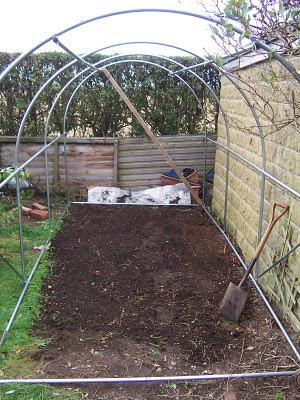
Poly tunnel frame, ground prepared for the bed etc. My mum wasn't overly pleased.


Constructing and choosing the materials was relatively easy. A little though was required to find the most cost effective way but carefully searching the internet and recalling some long forgotten physics helped.

The poly tunnel was purchased from ebay for £90, 4m x 2m, with careful packing it can fit a good sized collection. The heating element and thermostat were also purchased from the internet at a price of £80. A cubic metre of perlite and expanded clay was delivered to my door for £120. We had some old fence boards at home which helped but timber to build a bed can be acquired for £30. A fan heater £20, plus RCD breaker and extension cable for £10. The electricity used over the winter will be minimised through setting the thermostat as low as possible. In total, around £400 spent to safeguard the current financial investment and six, seven years of work and some future masterpiece trees....even if I do say do myself.

The bed was constructed and the path of the 25 m cable planned out. It was just as planned. The walls of the bed are old fence panels fixed together and held in by posts. It isn't the most permanent of structures but it will last the winter

A very thin layer of perlite was spread out over the base of the bed and the heating wire set out. On top of this, about 15 to 20 cm depth of perlite. If the temperatures were much higher, then over heating would be an issue, however we are aiming at minimal temperatures, just keeping it above freezing


I chose Perlite as the medium for the heating bed as it came out on top in several important factors; specific heat capacity, thermal conductivity and price per volume. It requires less energy to heat up, it retains heat and moisture incredibly well and is cheap. I will reuse it for my potting mix for freshly collected trees, whips, sick trees etc. I am a firm believer in Perlite for certain situations and having a cubic metre next spring is not a problem, I will keep the bed for problem trees I think. I topped off the perlite with a layer of expanded clay, slightly more expensive but heavier and larger particle sized, offering another layer of insulation and stopping the perlite from blowing away either from the wind or the hosepipe. The only issue with Perlite is the dust that comes with it, breathing it in is not a good idea, so I opened a hole in the bag, stuck the hosepipe in and made it damp. The hosepipe was used to stop any more dust from flying up when pouring out as well. A dust mask is advised.

All the trees in, some are buried in the bed pots and all, other stronger trees are left unprotected but will be wrapped when the weather turns.

You may notice that the deciduous trees are still in leaf and it is incredibly early to be preparing, however I am away almost all of October and there have been long range forecasts which predict snow soon. Better safe than sorry.

Heater and grow lamp. Heater is not pointing towards trees, on the lowest frost guard setting and on 1KW rather than the max 2KW setting. Lamp is above pines, junipers, yew and rosemary trees Still a considerable distance though, at most 1.5 m, closest is 1m

One other feature I have included which I have used every year in the smaller greenhouse is the grow light. A 250 W system which gives artificial sunlight, as close to the normal spread of wavelengths from the sun as possible. Why do this? All deciduous tree which lose their leaves do not need sunlight whatsoever and could be kept in a pitch black garage until close to spring time. Those evergreen trees which still have leaves are slightly different and require a little sun to see them happily through the winter. The idea is not to keep the growing throughout the winter, but just to keep the engine at idle and not stall. Once spring begins and we have natural sunlight, the trees start off quicker and grow much better. Mediterranean species and Japanese pines and junipers are not used to the grim Northern winters and so a touch of sunlight is essential for happy trees. It is not essential to keep them alive, but just to keep them happy I would advise investing in one. Prices start from £80 for a small system. I run mine on a timer, giving around 3 hours of sunlight a day, from November through until end of February. At around 1 Kwh of electricty per day that is roughly 15 p a day, lets say tops £20 a winter. The bulb has a tendency to blow or need to be replaced every four months, so thats another £15 a year. I'm still well under the £10k and years of work I threw away over the last few years.

Protect the electrics...the big white box is the ballast for the light. The other box is the thermostat. They are splash proof but use a safety RCD at the main socket just in case. With a 250 W heating cable, a 250 W light and a 1 KW heating fan, there is a lot of potential power going through there.

In conclusion...the basic rules for winter protection are to:

  1. Keep the roots from freezing, expanding and dying. This is achieved by insulation and minimal watering. Regulate water intake, bury or wrap trees in something...even snow is better than exposure to wind.

  2. Shelter from winds, especially the cold north winds

  3. Allow the trees to go dormant. Do not over heat the greenhouse and keep the trees from going dormant.

  4. Get as much natural sunlight as possible. Ideally supplement with grow lights.

Please give more consideration to the winter...even if it is just burying the trees in the ground, you don't have to go too far...just act now before it is too late.

Tuesday, 6 September 2011

Autumn is here...


It has been a while since the last post and I have been up to a few things, including another outing. This last weekend saw an interesting event in Crawley, namely Bonsai World 2011. It was the first time it had been held and was a good weekend, I got to meet up with the usual suspects and catch up, have a chat and look at some trees. There were some lovely trees on show, some at a high level, others not so, but all well presented and everyone had fun with it, which lets face it, is the point of doing bonsai. It was a well put together show and congratulations to all involved.

In an unusual turn of events I chose to put on a display, a favourite tree of mine was just about ready to go and it seemed appropriate to get it out. Although not quite in colour, there is a hint of red coming through there and it is perfect for the season as we are just about to start autumn and soon the leaves around us will be on fire...not literally I hope. The tree I displayed has previously been seen at a never to be repeated exhibition up North a couple of years ago around the same time. It is a sadly not often seen variety outside of Japan and one of my favourite trees...this Sumac or to be a bit more specific, Rhus succedanea.


It is potted in a Shidei or purple clay Chinese pot from around 100 years ago, there is no seal but it is a Meiji period design. It has been well used and has developed a good patina around the whole pot without sustaining any significant damage. It has taken on quite a shine which does not come from oiling the pot up before exhibiting which is something I am not keen on. The black lacquered board it is displayed on is the same one used in my Joy of Bonsai display a while back. I do have other boards, including a bamboo one I did think of using but it seemed slightly unseasonal and also clunky. The simplicity of the black rectangle appealed to me...and both Apple and Samsung apparently.

Only one person asked me why I didn't use an accent or a scroll, and the answer was that it didn't need it. The space was small enough as it was and the feel of the tree would have been destroyed if there was anything else going on there. To have created a busy display which conformed to a three item combination would have destroyed the simplicity of the tree and left it feeling mechanical and contrived. I had an ideal early autumn scroll but it was slightly too long and the colour too much of a contrast against the white back drop. It was a shame as I wanted to use it. I was happy to be on the end of the row as the extra space next to the display was helpful. It also helped to have some stones on the other side so I wasn't over powered by some massive tree.


The art of bonsai display is the art of successfully using space to create the impression of something larger than what is seen with the eyes. Space can be oppressive if seen with preconceptions of "tree, scroll, accent", there is a desire to fill it up. If freed from such self imposed conventions, the space can be liberating, allowing the viewer to imagine.

I am not sure how the displays that I have done in the past have been taken and I don't know if people expect for me to be displaying big impressive trees to show off my skills and professionalism and win prizes. I personally take the opportunity to show that there are alternatives, different aesthetic ideas and motivations for doing bonsai...

And then show off on the Blog.

Thanks to everyone at the show for making it fun, but especially to Simon Haddon who let me use his camera because I typically forgot mine.

If you think all the above is a bit pretentious and speaking in riddles, it's because I have been reading some books. Aye...proper ones. Been very enlightening.

"He who only knows, without seeing, does not understand the mystery. Even should every detail of beauty be accounted for by the intellect, does such a tabulation lead to beauty? ...The scholar of aesthetics...tries to make seeing proceed from knowing, but this is a reversal of the natural order. The eye of knowledge cannot, thereby, see beauty"

from The Unknown Craftsman by Yanagi Soetsu

So does that mean I wasted all my time reading books?

"A man should avoid displaying deep familiarity with any subject...it is impressive when a man is always slow to speak, even on subjects he knows thoroughly, and does not speak at all unless questioned."

from Tsurezuregusa or Essays in Idleness by Kenko

Oh...I will shut up then.

Wednesday, 17 August 2011

Chinese Drunkard


In the course of my recent writings, I have found the internet a constant source of amazement and time wasting. None more so than reading the poetry of Li Bai, one of the great Chinese poets of the Tang Dynasty so I have come to learn. Now he is a man of great distinction in my book, possibly due to his incredible fondness for alcohol, the moon and rambling around in the mountains.
I sometimes look back in history, see the simple and pure lives they had and wonder how far we have actually come with civilisation. Sure, we have ipads and can now watch sky sports for free, but are we really happy?

Maybe if we take Li Bai's advice we will be...

If heaven loved not wine,

A Wine Star would not be in heaven;

If earth loved not wine,

The Wine Spring would not be on earth.

Since heaven and earth love wine,

Need a tippling mortal be ashamed?

The transparent wine, I hear,

Has the soothing virtue of a sage,

While the turgid is rich, they say,

As the fertile mind of the wise.

Both the sage and the wise were drinkers,

Why seek for peers among gods and goblins?

Three cups open the grand door to bliss;

Take a jugful, the universe is yours.

Such is the rapture found in wine,

That the sober shall never inherit.


I will buy a pint for the first person to tell me how I got to reading that poem....